
Every AI girlfriend app advertises a price that is lower than what you will actually pay. That is not an accusation, it is how the category is built. The number on the pricing button is a floor, and the real monthly cost sits somewhere above it, hidden inside token meters, renewal jumps, and annual commitments that the checkout page shows you only after you have entered a card.
I have spent the past few months running these checkouts myself, from a live EU IP, on the apps we rank. Not reading the marketing pages. Sitting at the actual payment screen and reading what it charges on the first cycle versus every cycle after. What I found is a small set of pricing tricks that show up again and again, some of them used by apps that most review sites list as completely separate products when they are not. This is a field guide to those tricks, and a five-minute method to check any app before you commit.
Pricing here is based on live checkout observation across the apps in our catalog, anchored to a nine-app pricing audit run on May 10, 2026, and re-checked against current vendor pages. Prices in this category move constantly: promotional rates rotate, monthly figures get raised without notice, and regional VAT changes the total at the last step. Treat every number below as a documented snapshot, not a permanent quote, and confirm the live checkout before you pay. I did not commission any vendor billing data, and I did not test every plan tier on every app.
The one rule that makes AI girlfriend pricing readable
If you remember nothing else, remember this: the advertised price is the entry fee, not the running cost. Almost every app in this category separates the subscription from the features people actually subscribe for. You pay a monthly fee to lift the basic text limit, and then the photos, voice messages, and video clips run on a separate currency that your subscription only trickles out.
Once you read pricing that way, the whole market gets easier. The question stops being “which app is cheapest” and becomes “what does this app charge for the thing I actually want to do.” Here is how the advertised floor compares to the realistic cost across the models we see most.
| Pricing model | Advertised floor | What drives the real cost | Example apps |
|---|---|---|---|
| Token / credit metered | $4 to $14 / mo | Media (images, voice, video) burns a separate balance the subscription barely refills | Candy.AI, DreamGF.AI, DreamBF, OurDream.AI |
| Flat single tier | $10 to $20 / mo | Predictable. One price, media included or posted up front | SecretDesires.AI, SpicyChat.AI paid tier |
| Freemium bait | $0 | Usable for minutes, then a hard cap forces the paid tier | Most apps with a “free” button |
| Real free tier | $0 | Actually usable long term, throttled but not walled | SpicyChat.AI |
The gap between column two and column three is where the traps live. Below are the six I see most, in the order they cost people money.
Trap 1: The intro price that only exists once
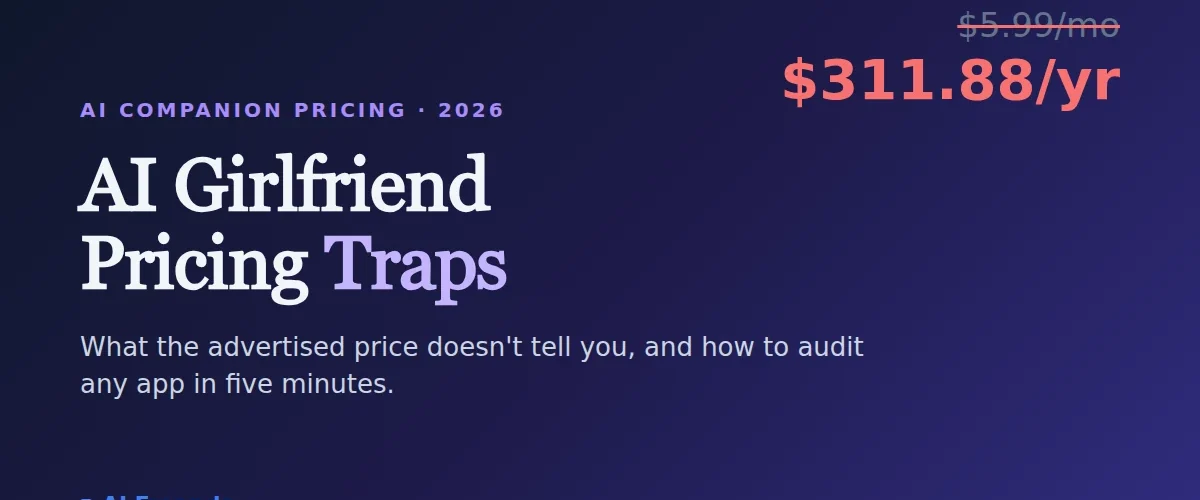
This is the most expensive trap in the category, and the checkout page is designed so you do not notice it. The app shows you a discounted monthly rate with the “standard” price struck through next to it. What almost nobody registers at the payment screen is that the struck-through number is not marketing decoration. It is the price you pay on every renewal after the first cycle.
DreamBF is a clean example because I read its checkout line by line. The annual plan advertises $5.99 per month, which bills as $71.88 for the first year. The struck-through standard rate is $311.88 per year. So the app takes $71.88 now, and unless you cancel, it takes $311.88 twelve months later, when you have long since forgotten you signed up. The monthly plan runs the same pattern: $12.99 as a first payment with $25.99 struck through, and that $25.99 is what recurs. This is not a bug or a lapsed promo. It is the standing pricing structure, and DreamGF users have flagged it in community threads for over a year.
On any app that shows a discounted price with a higher number crossed out, assume the crossed-out number is your renewal rate. The headline is the first cycle only. If you cannot find the recurring rate in writing before you pay, that is the answer: the recurring rate is the high one.
Trap 2: Tokens stacked on top of the subscription
Six of the seven main apps I audited charge a subscription and then meter the features people came for. You are not buying access, you are buying an allowance. Candy.AI includes a small monthly token grant on paid plans, and the DreamAI network apps include 150 tokens a month. That sounds like a lot until you price what tokens buy, and the answer varies more than anything else in this category.
In August 2026 I bought paid accounts on twelve of these apps and measured what a single generated image actually costs. The spread is the most striking figure in this whole category:
| App | Cost per image | What the monthly allowance covers |
|---|---|---|
| SecretDesires.AI | about 3 cents | roughly 333 images |
| OurDream.AI | about 6 cents | roughly 200 images |
| Secrets.AI | about 15 cents | roughly 160 images |
| Candy.AI, DreamGF.AI, DreamBF, eHentai AI | about 20 cents | 50 to 75 images |
| Infatuated.AI | about 21 cents | roughly 33 images |
| JustPorn.ai | about 90 cents | 10 to 20 photos |
| Joi | about $1.20 | roughly 16 photos |
| Swipey.AI | about 5 euros | 8 photos |
That is more than a hundredfold difference for the same action, measured against what the monthly allowance covers, and over two hundredfold if you compare the marginal cost at each vendor’s cheapest top-up pack. Either way it does not track the subscription price at all. The full breakdown, with the method and the screenshots, is in what a generated image actually costs. JustPorn.ai carries the cheapest sticker in the DreamAI family and the most expensive photos in it. Swipey.AI charges 19.99 euros a month and gives you eight pictures for it. SecretDesires.AI charges $7.99 and gives you over three hundred.
Before you subscribe anywhere, work out the cost of the one action you actually came for. It is the single most useful number in this category and no vendor puts it on the pricing page.
In practical terms, on the DreamAI-family apps a 150-token monthly allowance works out to roughly 50 minutes of voice call or about 75 generated images before you are topping up with real money, measured on paid accounts in August 2026. Note that these are not the rates the vendors publish: the DreamAI family’s own membership terms still quote figures five times higher, so the app is cheaper than its own documentation claims. Starting a new companion costs 5 tokens on the live account, not the 20 the terms state. If you are the kind of user who wants to generate a few photos and hold a voice call most days, you can still clear the allowance, though it takes longer than the published rates imply. Where the cost really escalates is video: on OurDream.AI a clip costs 100 coins against a 1,000-coin monthly grant, and on Joi a five-minute video call costs 3,500 Neurons, roughly $70. Even so, the “cheap” $5.99 app can still become a $30 to $50 app once video enters the picture. Independent roundups have documented heavy Candy.AI users landing well past $50 a month once token top-ups are counted, and that is entirely consistent with what the token pricing implies.
This is why the flat-tier apps deserve more credit than they get. SpicyChat.AI runs a tier-based model with no token meter on its paid plan, so the paid price is the price. SecretDesires.AI meters media through Hearts but at rates so low it barely registers: an image costs 0.3 Hearts, about three cents, and standard chat consumes nothing at all. When media is the whole point of the product, a slightly higher flat fee is often cheaper than a low fee plus metered extras.
Trap 3: The “annual” price that is really a year paid up front
The lowest monthly figure an app shows you almost always requires annual billing. “$3.99 per month” is not a monthly plan, it is an annual plan divided by twelve for the ad, and at checkout you pay the whole year in one charge. That is a real commitment on a product you have used for a few minutes.
Two things make this worse than it looks. First, the annual rate is frequently the intro rate from Trap 1, so the low number is doubly conditional: you pay a year up front, and the renewal is at the higher standard rate. Second, several apps do not offer a genuine month-to-month option at all anymore, which means the only way to try the product without a large upfront charge is a free tier, if one exists. When an app removes the monthly option and hides the recurring annual rate, those two choices together are the signal.
Pay monthly, or use the free tier, for at least one full month before you touch an annual plan. You are testing whether the memory holds, whether the media quality is worth it, and whether you will still be using it in week three. Annual billing saves money only on an app you have already decided to keep. Apps that make monthly billing hard, or skip it entirely, are removing your ability to make that decision safely.
Trap 4: Four “different” apps run by one company
This is the trap that no other review site I checked will tell you about, and it is the one that quietly wastes the most comparison effort. Several of the apps presented across the web as distinct competitors are the same product wearing different brand names.
DreamGF.AI, DreamBF, and eHentai AI run the same checkout interface, the same prices, the same 150-token allowance, and the same benefit list. Byte for byte. JustPorn.ai uses the same template at a lower price tier. All four are operated by DreamAI SRL, registered in Bucharest, Romania. DreamGF discloses the network openly in a footer block labeled “AI Network,” so this is not a secret, it is just something nobody reading a “best AI girlfriend apps” listicle is told. When you compare DreamGF against DreamBF to find the better deal, you are comparing a company against itself, and the intro-versus-renewal trap is identical on both because it is literally the same billing system.
If an app disappoints you on pricing or refunds, its sibling apps will disappoint you the same way, because they share a billing backend. Knowing that DreamGF, DreamBF, eHentai AI, and JustPorn.ai are one operator saves you from “switching” to what is functionally the same checkout. It also tells you that a bad refund experience on one is a bad refund experience on all four.
Trap 5: Refunds that vanish the moment you use the product
Read the refund clause before you read the price, because on several apps the refund is engineered to be unreachable. The DreamAI network apps remove refund eligibility after any usage. OurDream.AI removes it once you cross a usage threshold, documented around 25 percent of your allowance. The mechanics are simple: you buy an annual plan, you generate a few images to see if it is any good, and in doing so you have consumed credits, which voids the refund.
Stack this on top of the intro-versus-renewal trap and the annual-upfront trap, and the picture is clear. On these apps, an annual commitment is a real commitment. You cannot properly test the product and keep the option to get your money back, because testing the product is exactly what removes that option. That is a design choice, not an accident.
Trap 6: The number aggregators quote is the best case, not the price
This one implicates my own corner of the internet, so I will be direct about it. A lot of AI companion “review” sites and comparison tables quote the lowest number an app can produce, the annual-plan monthly-equivalent, as if it were the price you would pay. It makes the app look cheaper than it is, and it makes the affiliate site’s pick look better.
Candy.AI is the clean example. The roughly $4 per month figure that gets waved around in listicles is the annual plan divided by twelve, which means a full year, about $48, charged up front. Pay monthly instead and it is closer to $14. Then add the tokens that image and voice users end up buying, and the realistic monthly cost lands somewhere between $20 and $80. So the sub-$4 number that circulates as “the price” is the floor of the floor: annual-only, and before the metering that most paying users hit. Several apps also rotate promotional discounts that comparison tables freeze into “standard” listings, which has the same effect. When you see a price that looks dramatically lower than the rest of the category, assume it is a best-case annual-equivalent or a temporary promo, and the site presenting it as the everyday price earns a commission when you click.
How to audit any AI girlfriend app’s pricing in five minutes
You do not need me for a specific app. You need a method you can run on any checkout page yourself. Here is the one I use.
Find the recurring rate, in writing
Ignore the big discounted number. Look for the struck-through or “standard” price, and confirm what recurs after the first cycle. If the recurring rate is not stated before payment, assume it is the high one.
Check whether media costs tokens
If images, voice, or video run on “tokens,” “coins,” “gems,” or “hearts,” the subscription is not your real cost. Find the monthly allowance and what one image or one minute of voice costs, then multiply by how often you would use it.
Confirm a true monthly option exists
If the only real plan is annual, the low monthly figure is a year paid up front. No month-to-month option and no free tier together mean you cannot test before committing.
Read the refund clause for a usage trigger
Search the terms for “usage,” “consumed,” or “generated.” If using the product voids the refund, an annual plan is non-refundable in practice the moment you actually try it.
Check who operates it
Scroll to the footer and privacy policy for the operating company. If it matches an app you already rejected, it is the same product. This is how you avoid “switching” to a sibling app with identical pricing.
Who should pay what
The right pricing model depends entirely on how you use these apps, not on which one has the lowest sticker.
- Light or text-first user: A real free tier or a low flat tier is your best fit. SpicyChat.AI’s free tier is usable long term, and its paid tier does not meter messages. You do not need to touch a token app.
- Heavy media user (daily images or voice): Avoid token-metered apps, or budget for the top-ups honestly. A flat single tier like SecretDesires.AI is often cheaper than a low base fee plus constant token purchases, even though the sticker looks higher.
- Just curious, testing the water: Never hand a card to an annual plan. Use a free tier, or pay for one month, and set a cancellation reminder for the day before renewal. If an app blocks both of those paths, walk away.
- Long-term, one companion: Once you have run a month and decided to keep it, annual billing on a flat-tier app is the honest saving. On a token app, “annual” saves you nothing if the media metering still applies, so price the tokens first.
The advertised price of an AI girlfriend app is the floor, not the cost. The real number is set by token metering, the renewal rate hiding behind the strike-through, and whether “annual” means a year paid up front on a product you cannot refund once you use it. Before you pay, find the recurring rate in writing, price the tokens for how you actually use the app, confirm a monthly or free option exists, read the refund clause for a usage trigger, and check who operates the app so you do not switch to its own sibling. Five minutes of that beats any ranking, including mine.
The takeaway
None of this makes AI companion apps a bad deal. Plenty of people get real value from them, and a flat $15 app you use every day is cheaper than most subscriptions people never think twice about. The problem is not the price, it is that the price is engineered to look lower than it is, and most of the sites ranking these apps have a financial reason to leave that engineering unexplained.
So the honest recommendation is not an app, it is a habit. Read the checkout, not the ad. Price the feature you actually want, not the entry fee. And when a site tells you an app is dramatically cheaper than the rest of the category, check whether that number survives the next renewal. If you want the full app-by-app snapshot behind the examples here, I documented the live checkouts in our Replika alternatives pricing audit, and the individual numbers live on each app review. If an actually free option is what you are after, our best free AI girlfriend apps list separates the real free tiers from the bait.

Related Articles
 Guides
What Is an AI Girlfriend? Complete Guide for 2026
Everything you need to know about AI girlfriend apps — what they are, how they work, and how...
 Guides
Best Candy.AI Alternatives: 5 Apps That Rival the Premium Experience
Love Candy.AI's quality but want something different? These 5 alternatives offer similar premium experiences with unique strengths.
 Guides
Best Replika Alternatives for Deeper AI Conversations (2026)
Replika pioneered AI companionship but has fallen behind. These modern alternatives offer deeper conversations, better memory, and more...